
Good in theory?

What is architectural theory anyway and why does it exist? What’s it do? In non-architectural fields we have theory and the application of theory. In this sense, theory is a synonym for a knowledge base that becomes larger and more solid over time, along with its application. This has served us well. We don’t have theories of medicine or law. In science, theories are postulated and are either proven right or wrong and, either way, the knowldege base becomes richer. Architecture does not work like this. If it did we would have surely perfected the art of building by now.
Architectural theories come and go. None are ever proved or disproved. They just fall out of favour as newer ones take our fancy. This is not the way of a serious discipline. To learn about architectural theory is to learn about what ones have come and gone so you can devise your own [!] You could do worse than read this. It’s available as a download [here].

New architectural theories may well advance the cause of architecture but all have the fault of not improving our understanding of it or, indeed, improving our lot. When was the last time a new formal language for architecture* did anything for you?
WORDWATCH: Notice that a “new formal language for architecture” doesn’t exclude derivative buildings resulting from the architectural representation of motifs and devices lifted from painting, lierature or music? This is usually the case with architecture. If we’re going to be talking about characteristics unique to architecture then the word formalist should be used – in which case the “for architecture” is redundant.
Thinking back over the past century or so, all the lasting architectural inventions are formalist ones. Despite all Frank Lloyd Wright’s grand claims, the big roof sheltering what’s below, the corner window drawing our attention to a part of a building that formerly delineated a space, and joining up of small spaces to make larger ones were all formalist inventions in that they were devices unique to architecture. All have lasted longer than Wright’s anti-formalist theory of organic architecture that claimed the essence of architecture was to be found in something outside architecture.
For all Le Corbusier’s failures, he did draw our attention to large-scale volumes that could be walked through as they interrupted light. This is formalist. The Five Points are formalist. Whether or not they were always necessary and sufficient devices with which to configure any building is another matter. Corbusier’s drawing our attention to columns and beams is not so much a “new formal language for architecture” (or even a reinterpretation of an old one) but a new way of telling us that buildings are things that are built. This was a powerful thought because it chimed with the existential nature of buildings, and has proven very resilient. Le Corbusier built his career on representing this formalism. [The careers of the New York Five were built on representations of 1930s representations of this fundamental formalism.]
Functionalism configuring a building as an allocation of functions and spaces was formalist. Articulating them as sculpture wasn’t. Much of architecture is not about architecture. Speaking of Functionalism, setting quanititative goals and achieving them was once what architects did for society but, almost immediately, qualitative goals started to come into play and some imaginary tradeoff between them set the course for most of 20th century architectural endeavour, beginning with Gropius suggesting quantitative criteria weren’t everything, and Le Corbusier declaring architecture was all about qualitatively correct and masterly lighting effects.
This split between the quantitative performance aspects of a building and the qualitative [for want of a better word] “architectural” aspects of a building is still with us. Quantitative structural performance is relegated to engineers, quantitative costruction performance the role of contractors and project managers, quantitative energy performance for building physicists to take care of, sustainability outsourced to sustainability consultants and so on.
Anything that can be quantified is no longer considered part of the core skill set of architects and that core skill set is ever shrinking. The only skill left to defend is that of … of … what’s it called? It’s probably something to do with arranging stuff in value-adding ways to delight us, to somehow make us feel better for experiencing this stuff called architecture. The surface attributes of buildings are strongly implicated, shape in particular. If theory is no more than what is presented as theory, then it’s more akin to myth-making and its vulgar relative marketing than it is to any underlying endeavour to uncover the truth of things. This is symtomatic of the Post-Modern world in general.
Energy performance and sustainability were the most recent challenge to the traditional dominance of shape as the dominant architectural aesthetic. They implied building virtue was at least as if not more important than building beauty. The fact that an optimum shape of a building could be arrived at empirically was anathema to architects who reacted in horror to this infringement on their patch. Sustainability was relegated to the building sciences even though principles of environmental or energy performance could be chosen and presented as generators of shape. [Norman Foster, Richard Rogers and Renzo Piano all made their careers doing this.]
Theory distracts us from looking and learning and extracting applicable ideas from buildings. Building an efficient enclosure for people to inhabit as best they could is one of the useful things I’ve always believed I’d learned from Kazuo Shinohara’s 1973 House in Uehara, even though it was presented as architecture of the highest order.


Leaving aside for now the intruiging notion of what makes a free subjectivity different from any other kind, just look what happens when theory gets hold of even the potential for something useful.
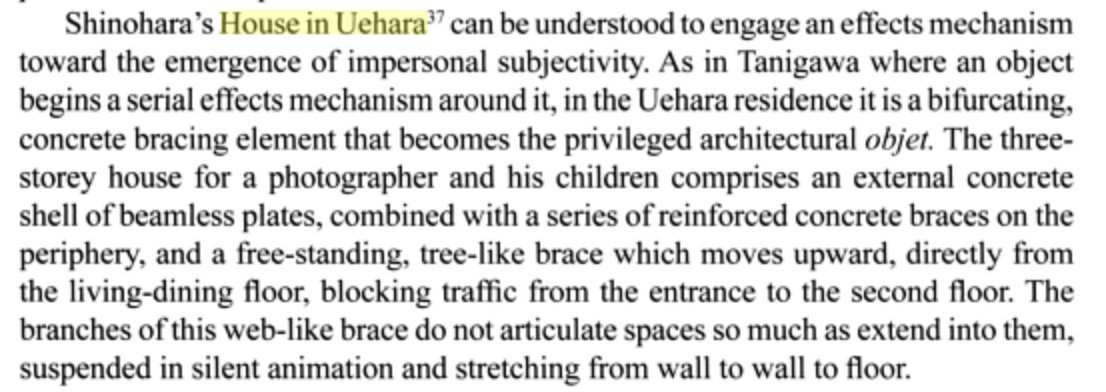
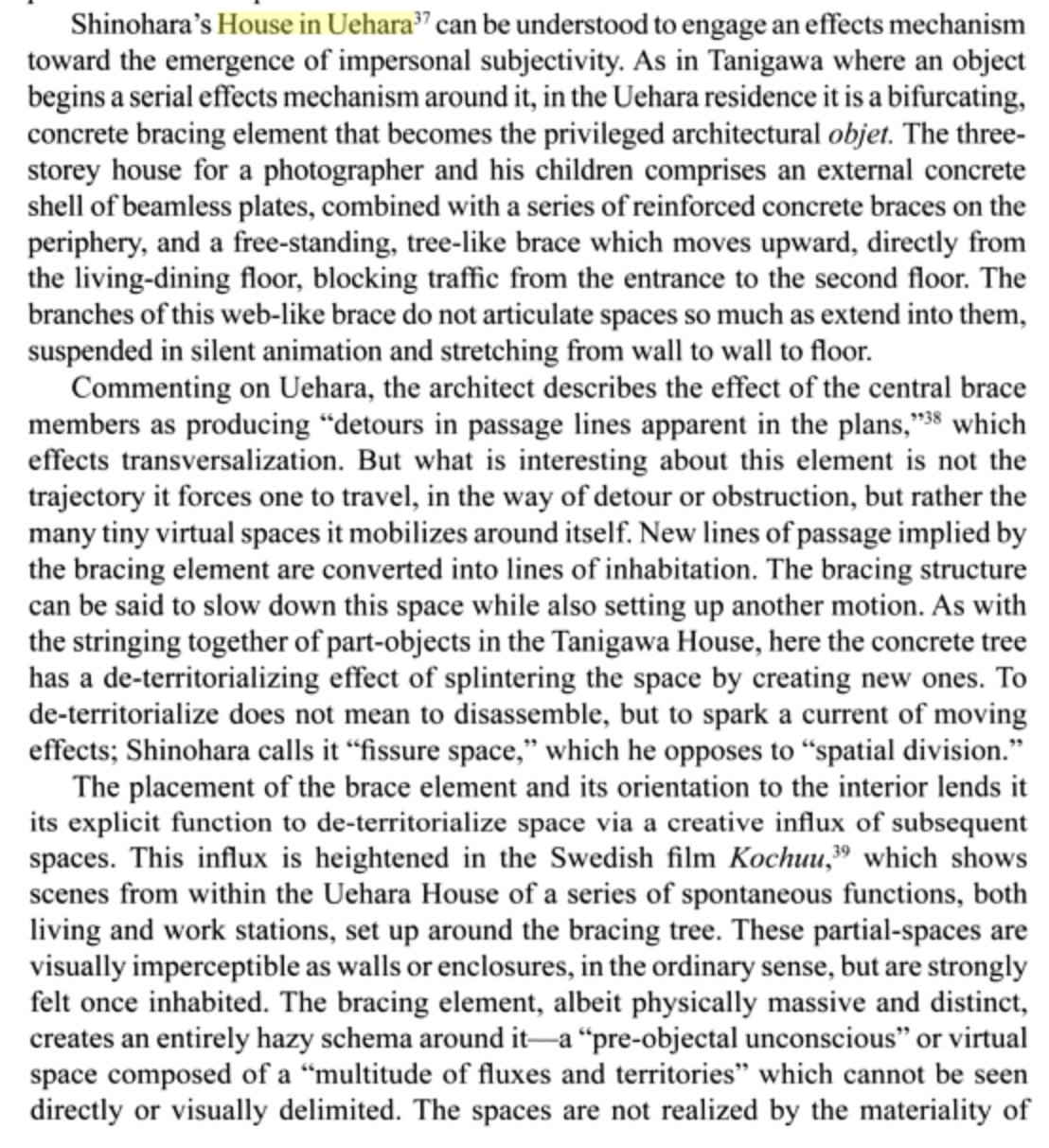
We’ve come to believe good architecture and useful ideas such as efficiency or performance are opposites and this only works to keep architectural theory distant from anything that can be quantified, corroborated with facts or proven by evidence.

Anything that can be quantified is not a problem. The combination of technology, science and human ingenuity continues to devise new ways of providing more of the things we need and by using less energy and resources to do so. The performance aspects of buildings aren’t the problem. Using them to generate architecture seems to be and instead of a quantitative measure for architectural quality we get given architectural theory instead. On the whole though, an era gets the architectural theory it deserves. It’s just a shame that we have to live with it.
Remember the 1980 and Bernard Tschumi’s brilliant idea of juxtaposing different frameworks to generate unexpected juxtapositions? What did it do? Where did it go? Parc de la Villette is the usual example given to illustrate that people thought like this once.

There’s some grassy patches, a winding path and some red structures each having their own logics of placement but approximately the same conceptual weighting. As a day out, it’s nice to be in a park but nobody knows whether or not this particular arrangement is more enjoyable than an infinite number of others.

Peter Eisenman’s 1989 Wexner Center for the Arts generated sentences like these next.
While not entirely disconnected from its context, the building is for the most part a self-realizing and autonomous work, creating its own unique and self-contained methodological process and architectural vocabulary. The museum purports to make no apologies for its unorthodoxies; quasi-historical quotations reference architectural tradition only to boldly reject it. Formal devices deprived of functionalist purpose disavow spatial convention. And a number of deliberately awkward and discordant moments complicate the intersection of built space with its human occupation. For Eisenman, these are among the great successes of the building, as they manifest the discourse of deconstructivist emancipation into actualized form.
We have the juxtaposy thing again, this time with buildings, or bits of them.


Eisenman used to talk of “banana space” – the contrivedly awkward spaces that sometimes result when things collide. With the Sydney Opera House, the roof shells accommodate the performance spaces but only loosely. Those are some very big bananas.
The only one partially visible is the one for the Northern Foyer (to the left). This style of designing is still with us.

The gap between quantitative quantity and qualitative quality is a banana space of sorts and it’s the environment in which architectural theory flourishes while remaining separate from quantitative evaluation and, strangely, from qualitative evaluation as well. All manner of horrors are forgiven if something, somehow, advances the cause of architecture whatever it is or turns out to be. It’s hard to pin down so obviously it’s meant to be kept that way so architecture can remain isolated from any meaningful criteria for its evaluation. These two opera houses have skins exposed in the foyer and lobby spaces that are judged qualitatively even though the criteria are vague ones such as staircase drama, photo opportunities, wow factor …

It’s no accident Guanzhou Opera House is here. Architectural theory – or at least the many words of Patrik Schumacher’s The Autopoiesis of Architecture – not only justify this split but to magnify it. It’s a theory maybe, but not one we need.
Here’s something interesting! This document, Guangzhou Opera House Acoustic Design, mentions how it was the acoustic engineers who asked the architects to design the auditorium to have more curved surfaces. The parametric model then did what it was told. This makes you look at curvy surfaces in a different way doesn’t it? A quantitative way. These interior surfaces are no longer mere qualitative curvings and undulations, but functional [ ! ] in that they are doing useful things that can be quantitatively measured. As they must.

On the architects’ side, the parametric model no doubt reduced the number of design iterations as well as time and, in this sense, parametric modelling is a good and useful idea. It would have been nicer if the desired reverberation time and all the other acoustic variables had been parameters instead of leaving the Melbourne office of Marshall Day acoustic engineers to work it out using tools as primitive as sketches, cardboard models and ray tracing. They did well.
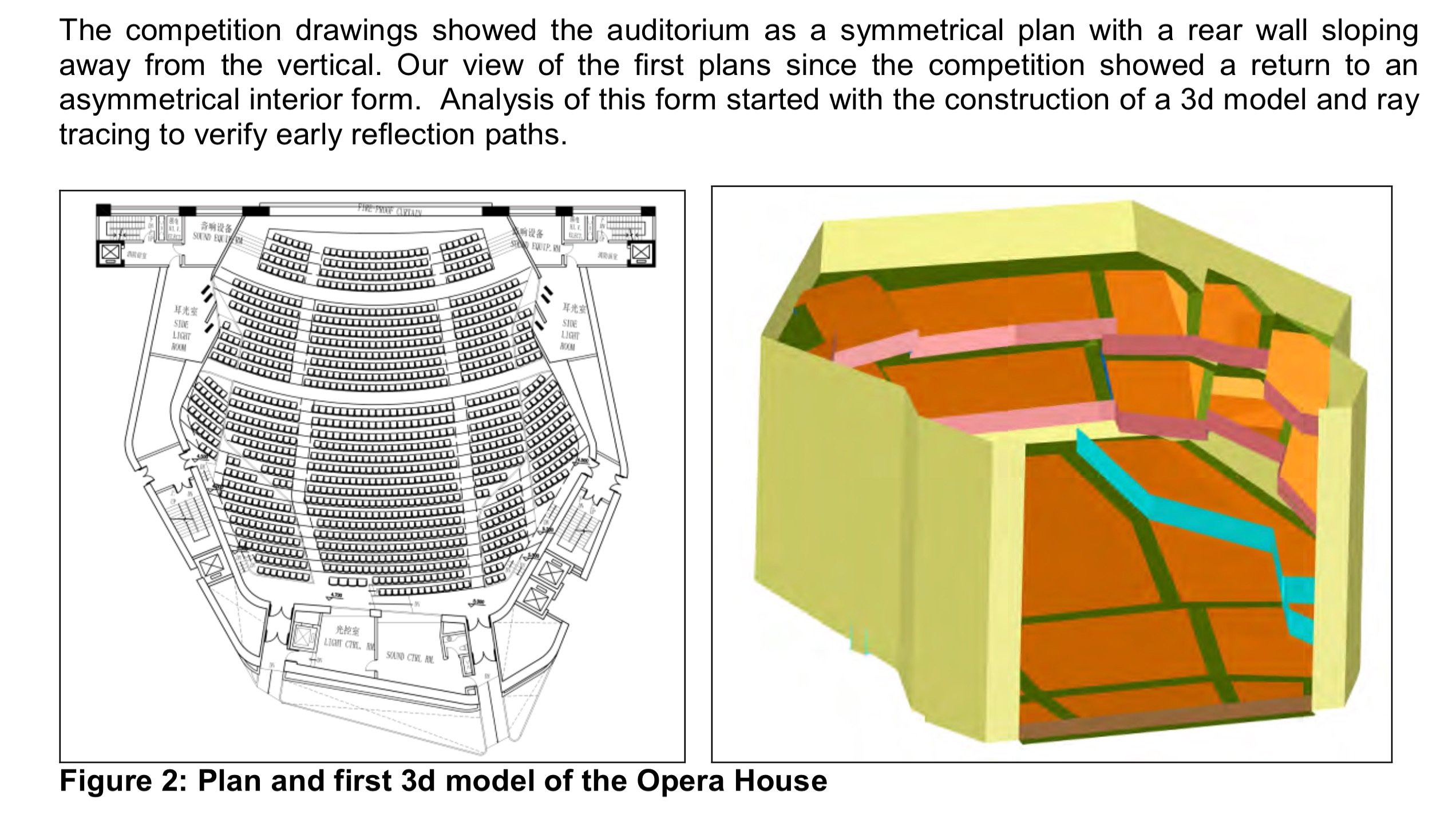
It’s one of those great paradoxes or architecture that the optimum reverberation time for an auditorium can be determined using cardboard models but designing a shape to accomodate an auditorium requires the equivalent of a small supercomputer.


Rather than claiming shape making as an autonomous discipline separate from function, climate, budget and, not to mention, the environment , it might be more useful if we had a theory that brought them all together. For this is what seems to be happening. It would be interesting to see what a parametric model could do if other types of quantative environmental parameters were input. We know there will be a few problems.
- Which parameters and variables are going to be chosen? These choices are design decisions in that they will affect the outcome. Currently, there are not enough parameters being chosen. (And even if they are, we are not being told about them, leaving us to think that parametric design is only good for shapemaking.)
- How are they going to be connected? We don’t know but we need to know if we’re going to pretend that we know anything.
- What weighings are going to be applied to those connections? Some will be more crucial than others.
- How are we going to calculate all this?
Until someone claims to have produced that, it might be better to distrust theory in general, especially the all-encompassing ones that encompass very little of consequence. The only general theory evident in the world of architecture today is the quest to monetise one’s product via aggressive promotion.
- Architects, particularly those from the Koolhaas stable, are best at this.
“This” refers not only to the buildings, but to secondary designer goods, and all other media content. Example.


A more recent article describes some 3D printed shoes designed by Zaha Hadid, Ben van Berkel, Fernando Romero, Ross Lovegrove and Michael Young for Rem Koolhaas’ nephew, Rem D’s coampany, United Nude. The first three are Big Rem’s media graduates. But where was “Best of class” Bjarke Ingels? Did he and Rem fall out? I only ask because this next brazenly disingenuous quote from a 2014 Rem Koolhaas talk seems to be a dig at the brazenly rapacious BIG and their ongoing success in America, something OMA never managed. [Fight! Fight!]
But Since when has OMA’s architecture been about the creation of community? Here we have a unified PR attempt to devalue the BIG brand – horrid as it is. Today’s architecture has it’s own rival groups that, as ever, are competing amongst themselves for A) clients, B) credibility and C) our attention. Basically, I agree with the headline. It just sounds a bit odd coming from OMA. I guess internet tiffs like this is our equivalent of the leaders of various architectural collectives writing articles in their respective journals a century ago.
• • •
So then, if one brushes up on theory and devises one of one’s own, what’s next?
- You could promote it endlessly and gain a reputation as a purveyor of theory, or at least opinions about how architecture is – such as Charles Jencks’ publications that for years tracked the zeitgeist in hope of another hit. Alternatively, you could take some aspect of current society and extrapolate to the extreme and claim that’s where we’re headed. Rem Koolhaas is master of this with his pre-emptive product placement theories that sooner or later a building will arrive to prove. Whether Koolhaas or Jencks, the level credibility is determined by the degree of credibility granted. Talk is cheap. Words are the ultimate architectural ornament.
- Alternatively, you could just refine your thoughts into a set of principles and apply them to the design of buildings. You may as well. This would be more useful, even if they needed revising and updating every now and then. Laurie Baker had a set. He wrote them down. I’ve always looked for simple ways to understand architecture and this is how one man made sense of it.

It’s not bad – but, even allowing that times have changed, I have an issue with No.6. Expressing” “individuality” through a quantity and configuration of building materials is absurd. Why not a ludicrously expensive wristwatch? An art collection? Soft furnishings? Clothes? Choice of friends? Topics of conversation? Personality? …
[cite]
Share this:


Malcolm Gordon William Millais
says:It would be helpful if what was meant by theory was explained. Normally a theory postulates something will happen, and it can be verified whether ‘this something’ happens, or not, in some form of real world.
For instance Le Corbusier’s Five Points are just proposals not a theory, and, as far as I can see, is everything else in this essay.
Laurie Baker’s 14 points that he thinks should be borne in mind when designing as building but do not constitute a theory. For instance how can ‘opulence’ or ‘snobbery’ independently defined?
Malcolm Gordon William Millais
says:It would be extremely helpful if what is meant by ‘theory’ was clearly defined. In my opinion a theory should postulate something that can be shown to be true, or otherwise, in some physical situation. Hence, Le Corbusier’s Five Points do not constitute a theory. Nor, as far as I can does anything else in this essay.