
Unbuilt References

There are buildings we use regularly and some of us may even experience some of them as architecture. There are also buildings we only know from photographs and understand to be architecture even though we have no first-hand experience of them as owner, visitor or user. Vladimir Tatlin’s 1919 Monument to the Third International, Antonio Gaudi’s 1908 New York Hotel and Frank Lloyd Wright’s 1956 The Illinois (Mile-High Skyscraper) are just three of the more well-known. The Monument to the Third International has a history of people wanting to believe it had been built.


Gaudi’s hotel had a brief moment in the sun when there was that call for proposals to rebuild the World Trade Center but it’s mostly forgotten now, save for exercises in supercharged AI excess.


Architecture has always had a fascination with proposals that never made it. These all suffered from being too visionary for their own good. El Lissitzky’s 1924 Wokenbügel and Mies van Der Rohe’s 1921 Glass Skyscraper were much smaller and equally impossible to construct given the technologies available at the time but nevertheless kept their place in architecture history but for only as long as we had this thing called the history of architecture that compiled all these references for us in things called books. Not many people are upset Boris Iofan’s 1935 competition proposal for Moscow’s Palace of the Soviets wasn’t built yet there are still people who don’t understand why Le Corbusier’s proposal wasn’t chosen. As with Tatlin’s Monument to the Third International, faux-aged, photorealistic renders have been made as if the building had actually been built and documented. “It seems the only thing more reprehensible than demolishing an architectural masterpiece is to not build it in the first place.1


It’s not nice to wish something had been built just to see how unworkable it would have been, but LC’s 1933 Plan Obus A for Algiers is an urban condenser in the sense that, once you’ve finished tearing along the elevated expressway you have to exit it sooner or later and enter a low-speed local traffic system to get to your destination and hopefully park somewhere near it. Having some type of horizontal elevators – let’s call them buses! – on the top might have made more sense.


There’s a not-really-so-fine line between the visionary projects that were simply ridiculous and nobody ever intended or expected them to be built, and those projects that could have been build but, for one reason or another, weren’t. Architects have always produced buildings of the former and then claimed them to be the latter. It’s better that way because the vision remains intact, unsullied by the practicalities of construction and cost. We’d remember The Metabolists less if more of their ideas had actually translated into buildings. But, for as long as there have been architects, there have been projects that were never built and that far outnumber those that were. I’m not sure I have a favourite unbuilt Metabolist project. Spoiled for choice. I’m glad Isozaki’s 1962 City in the Air didn’t have the opportunity to increase urban congestion at ground level.

For contemporary practices, unbuilt projects are a vast source of content that retains publicity and marketing value as long as the architect or architects are still practicing and, when they aren’t anymore, it fills monographs and fuels retrospectives. The unbuilt projects of OMA can fill books. Those proposed for the UAE could have a book of their own. Here’s an ArchDaily article2 titled OMA’s 15 Most Outrageous Unbuilt Skyscrapers. Dubai Renaissance hits all categories. The only one missing from the list and the only one I would miss is Museum Plaza Louisville but technically it’s not an OMA project as it was handed over to Joshua Prince-Ramus and REX architects as part of the divorce. I’d have gone out of my way to see it even knowing I’d most likely come away thinking it was disappointingly underscaled.

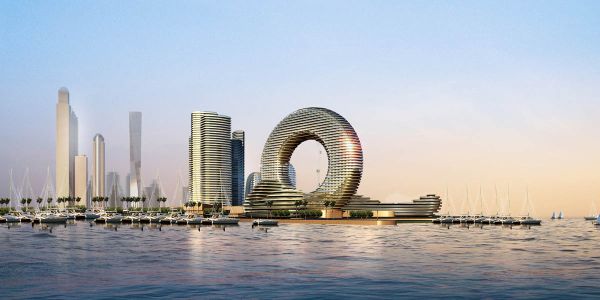
Pre-2008 Dubai3 had many buildings for which construction either never began or never finished.4 Most of them we don’t miss as we were never aware of them. Not all were masterpieces but many had some unique selling point. At one time, the building shown below was marketed as being the tallest residential building in the world (upon completion). It was never completed but nevertheless is a warning to “never build a pre-camber into your asymmetrically-loaded core in expectation the completed building will straighten it out.”


The Icon Hotel is a particular favorite of mine from this time in Dubai but it was only one of many projects fully documented in 2007 but never begun in 2008. Remember the rotating skyscraper?5 They were heady times.

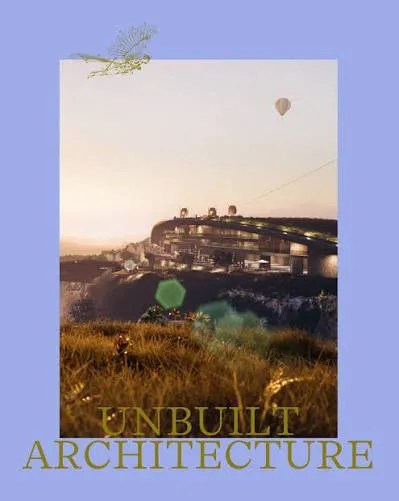
Judging by the number of books on the subject, there’s clearly a demand for more unbuilit masterworks. “Radical visions of a future that never arrived.” “Unbuilt Masterworks of the 21st Century.” What does it all mean? Perhaps it betrays a nostalgia for a time when we were optimistic about the future? And that architecture might be a part of it? Architecture is indeed in a very sad place when even the future was better in the past. Perhaps we are entering a Post-Visionary era in which the last thing the world needs or wants is more masterworks? I hope so.


As with many other things, AI isn’t helping. When generative AI can theoretically generate some insane number of ultimately unbuilt masterworks per second, we no longer have any reason to care whose name is associated with them. Or is this where the logic breaks down? Is AI even capable of generating a potentially buildable masterwork? If it were, I’d expect we’d know about it by now. Obviously I’m talking about the use of AI as a substitute for that equally black box we like to call human creativity.
But pick any architect and you’ll find some unbuilt projects that might once have happened and, amongst them, some you might find yourself wishing had been built. More people wish Shinohara’s proposal for the Euralille competition had been built than they do the Agadir Convention Center. Shinohara’s last work, the House in Tateshina was never built but that hasn’t stopped people writing about it, making models of it and generally trying to say something of academic value about it.6


A considerable number of Shinohara’s projects have now been demolished and others have either been remodelled or removed from their original contexts so it makes little difference whether they exist or not. Perhaps Shinohara was just being honest when he claimed he had no interest in his buildings once the owners took possession of them. He certainly understood that the value of the building as Architecture was not in its providing an architectural experience but for being an architectural reference. Every architect carries their own personal archive of such references and, in this archive, built/unbuilt, experience, image and memory each have equal weight. References aren’t filed in any particular order, or indexed by keywords or prompts and there’s no reason they should be. Nevertheless, thinking of one reference usually leads to another, which leads to another … Just as musical notation is of no use to theoretical physicists or the laws of mechanics being irrelevant to poetry, attempting to use words to index and access architectural references is simply not how it works. It’s not that I’m against words. They’re good for many things but one thing they can’t do is substitute for an architectural experience. The use of prompts implies an equivalence when it is really just keywords someone has loosely associated with certain aspects of certain images of buildings. Even the word “prompt” implies a causality without rationale. The field of prompt engineering wants us to believe that not getting a desired result is a matter of not getting the prompts right. Prompts can accurately retrieve examples of buildings have certain tangible characteristics of a building but they won’t categorize (and in doing so, describe) intangible associations those images of spaces might have for a viewer. Traditionally, these associations have been a major part of what we call the poetry of architecture but the brains we already have are still the only way we have to access and make use of these references. We’re no closer to knowing how architects ever manage to access those references to create something that’s not derivative yet at the same time the consequence of them all. We would save a lot of time and money and planets by first understanding how an architect’s brain draws upon its stored references before using our crude understanding and technologies to create poor proxies of a very small part of the process at ever increasing speeds.
• • •
- https://misfitsarchitecture.com/2017/11/18/the-history-of-forgetting/ ↩︎
- https://www.archdaily.com/774141/omas-fifteen-best-unbuilt-skyscrapers ↩︎
- https://misfitsarchitecture.com/2020/02/09/architecture-in-the-emirates/ ↩︎
- https://misfitsarchitecture.com/2020/03/01/the-uncompleted/ ↩︎
- https://misfitsarchitecture.com/2019/12/08/motion-sickness/ ↩︎
- https://ar.fa.uni-lj.si/2022/giorgia-cesaro-house-in-tateshina ↩︎


“The Orangery“
Share this:


Graham McKay
says:This post was me thinking out loud after a conversation I had last week. An instructor had asked students who their favorite architects were, or perhaps (worse) it was what architects they could actually name, and few could think of any. It got me thinking if architecture even exists if these sets of references are absent. Of course, in the world we now live in, there’s no-one to collect and curate them into things called history books. The idea of a “canon” seems archaic. There’s always ArchDaily “Classics” I suppose. Any sense made out of all these potential references has to be at the level of the individual. It’s not like we can filter and selectively store. For some things we can’t unsee we can only hope we’ll have no cause to remember them.
Roberto
says:Many, many years ago I was in Chicago and saw an exhibit of the work of a prominent Chicago area architect who practiced in the 1950s, I think. [Sorry, but I can’t remember his name.] I was 2/3 through the exhibition before I realized that almost nothing he had designed had been actually built. Wild shapes that would have been extremely costly to execute, if they were technically feasible at all. The experience made me realize that there can be quite a lot of dilettantism in architecture, for those who don’t actually need to make a living.
This post also reminded me of the (Bilbao-era) joke about Frank Gehry, who goes to make a project pitch to a wealthy client, and arrives back in his office several hours later to be met by his staff, who are curious how the pitch went. Gehry reaches for a piece of paper on the conference room table, crumples it up, tosses it onto the tabletop and says, “Build it.”